Showing posts with label sermons. Show all posts

Saturday, March 3, 2012

The Restoration of the Holy Images
Bishop Demetri M. Khoury
In the name of the Father, and of the Son, and of the Holy Spirit, One God, forever and ever.  Amen
Introduction:
It is a great pleasure for me to be here with you this evening.   This Vespers Service of the Sunday of Orthodoxy is one of those services which we all look forward in our Orthodox Church…   This is such a beautiful opportunity for us as Orthodox people to be together sharing the Faith which has established the Universe.   Here we are: a gathering of brothers and sisters in Christ, and of good friends in the love of God.
Today we hear sacred music and holy words which are to inspire us and to prod us on in our Lenten journey.   And so, having gathered here on the Sunday of Orthodoxy, we continue to tell the story of salvation, as lived, seen, and touched in our own human history.
The Historical Setting  READ MORE

Monday, October 24, 2011

Saint Demetrius day sermon
In the name of the Father, and of the Son, and of the Holy Spirit!
Today, dear brothers and sisters, we have gathered in this Holy church to glorify with our prayers St. Demetrius, the Patrone ofthis Holy temple and Parish.
I would like to humbly present to you the life of the holy Great Martyr St. Demetrius the Myrrh-Bearer of Thessalonica.
Our Lord declared: “If they persecuted Me, they will persecute you; if they kept my word, they will keep yours also. But all this they will do to you on my account, because they do not know Him Who sent Me” (Jn. 15.20-21). And so they did persecute our Lord, and they did persecute the Twelve, and so they continue to persecute his disciples, including the Great Martyr Demetrius, whose memory we ...READ MORE

Tuesday, May 17, 2011

Sermon on the Samaritan woman
Metropolitan Anthony Sourozh
8 May 1988
In the name of the Father, the Son and the Holy Ghost
The Holy Gospel has not given us the name of the Samaritan woman. But the Tradition of the Church remembers, and calls her in Greek - Photini, in Russian - Svetlana, in the Celtic languages - Fiona, in Western languages - Claire. And all these names speak to us of one thing - of light.
Having met the Lord Jesus Christ she has become a light shining in the world, a light that enlightens those who meet her. Every Saint is offered us as an example; but we cannot always emulate the concrete ways in which a Saint lived, we cannot always repeat their way from earth to heaven. But we can learn from each of

Wednesday, October 27, 2010

Why Do We Need The Church?
“When we stay within the embrace of our mother the Church, we can know that we are with our Lord.”
A frequent question we hear is “Why do we need the Church?” People want to know why they must go to a particular church, attend services they may not understand, obey rules that feel constricting to their lifestyle, and spend time with others they do not know or want to know. They say it is enough to talk to God in their own way, where and when they are in the mood to do so. They have lost the vision that our Lord’s purpose for incarnating as a human being was not simply to establish places to gather for rituals and coffee hour. “Church” is far more than buildings, rites and rules.
Why do we need church?so that we can know, experience and live within God, here on earth as well as in eternity. How can we possibly make such an incredible claim? On the one hand this life with God is difficult to describe in words, in the same way it is difficult to explain failing in love. On the other hand, Scripture is very clear that knowing God is precisely what He has in mind and to know God is to live in Him. He created

Tuesday, September 28, 2010

SYMPOSIUM
CHURCH GROWTH
CHURCH SUPPORT/GIVING (TITHING)
THE RESPONSIVE CHURCH IS A HEALTHY CHURCH:
A HEALTHY CHURCH IS A GROWING CHURCH!
A Presentation
given at the 5th Biennial Parish Council Symposium by
His Grace Bishop Demetri
Antiochian Village, PA
Friday, October 13, 2000
 I.) OPENING REMARKS:
On behalf of his eminence Metropolitan Phillip, Fr. Michael Massouh, the director of this Center, Mr. Ron Nicola, Chairman of the Department of Stewardship of the Antiochian Archdiocese and myself, I welcome you to this, 5th biannual Parish Council Symposium.
Our focus for this symposium is that of Church Growth and financial stewardship. Our speakers for this symposium will go into detail on our topics, and discuss ways in which we can begin to achieve specific goals. Today I will touch briefly upon these topics, and share with you some of my thoughts on these matters.
II.) INTRODUCTION: The Call to Godly Service:
Once a man entered a store where fine glass and chinaware were sold. Addressing the store-keeper he said, “I would like to purchase all the glasses that you have in your store which are pitched in the musical key of ‘A.’” The store-keeper looked amused, and said, “My friend, I don’t buy glasses here because of their musical qualities, so I am not able to select the ones which possess the proper key you desire!”
The man who had requested the glasses reached his hand into his pocket and took out a tuning fork. When he struck the tuning fork against the counter, every glass on the shelves that was pitched in the key of “A” immediately responded to the tuning fork with its own vibration in the key of “A.” So it is with the Christian heart -- the souls of all who are born of God -- who are tuned-in to the vibration of

Monday, June 7, 2010

Sermon of
Saint Augustine,
Bishop of Hippo
Today the Holy Church piously remembers the sufferings of the Holy Glorious and All-Praised Apostles Peter and Paul.
St. Peter, the fervent follower of Jesus Christ, for the profound confession of His Divinity: "Thou art the Christ, the Son of the Living God," was deemed worthy by the Savior to hear in answer, "Blessed art thou, Simon ... I tell thee, that thou art Peter [Petrus], and on this stone [petra] I build My Church" (Mt.16:16-18). On "this stone" [petra], is on that which thou sayest: "Thou art the Christ, the Son of the Living God" it is on this thy confession I build My Church. Wherefore the "thou art Peter": it is from the "stone" [petra] that Peter [Petrus] is, and not from Peter [Petrus] that the "stone" [petra] is, just as the Christian is from Christ, and not Christ from the Christian. Do you want to know, from what sort of "rock" [petra] the Apostle Peter [Petrus] was named? Hear the Apostle Paul: "Brethren, I do not want ye to be

Sunday, May 30, 2010

Saint Leo the Great on the Apostles Fast and its Significance
Saint Leo the Great (Sermon 78 - On the Whidsuntide or Pentecost Fast)
I. Since the Apostles' Day Till Now Self-Restraint is the Best Defence Against the Devil's Assaults.
Today's festival, dearly-beloved, hallowed by the descent of the Holy Spirit, is followed, as you know by a solemn fast, which being a salutary institution for the healing of soul and body, we must keep with devout observance. For when the Apostles had been filled with the promised power, and the Spirit of Truth had entered their hearts, we doubt not that among the other mysteries of heavenly doctrine this discipline of spiritual self-restraint was first thought of at the prompting of the Paraclete in order that

Thursday, May 20, 2010

Sermon on
the Feast of Pentecost
by St. John Chrysostom
Our father among the saints John Chrysostom, Archbishop of Constantinople, was a notable Christian bishop and preacher from the fourth and fifth centuries in Syria and Constantinople. He is famous for eloquence in public speaking and his denunciation of abuse of authority in the Church and in the Roman Empire of the time. His banishments demonstrated that secular powers had strong influence in the eastern Church at this period in history.
Let us spiritually extol the grace of the Holy Spirit in spiritual hymns, since spiritual grace has on this day shown upon us from heaven. Though our words are too weak to express adequately the greatness of this grace, we shall praise its power and activity to the extent of our abilities; for the Holy Spirit probes all things, even the depths of divinity.

Wednesday, May 12, 2010

 تذكار المجمع المسكوني الأول
وعظة الأحد
بسم الآب والابن والروح القدس الإله الواحد. آمين.
في هذا النهار المبارك، تُعيد كنيستنا المقدسة لتذكار المجمع المسكوني الأول، الذي أنعقد في مدينة نيقية، والذي به صار تأكيدٌ وتثبيتٌ للعقيدة المسيحية بعيداً عن الانقسام، وعن البدع والهرطقات إنجيل اليوم يُطالعنا فيه يوحنا الرسول بأن يسوع وقف ورفع عينيه إلى السماء مصلياً، وقال: "يا أبتي"، وكأنه بهذا يرشدنا إلى الطريق الذي من خلاله على كل واحدٍ منا أن يصلي، ويرفع عينيه إلى السماء. رفع العينين إلى السماء يعني أننا لا نرى إلا أياك أيها الإله الآب، يعني أنك أنت الوحيد الذي تستقطب أنظار عيوننا، أنك أنت الذي إليك نهتدي، ومنك نأخذ التعاليم والقيم.
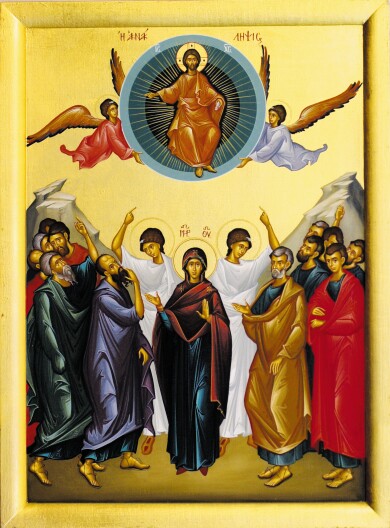
On the Lord's Ascension, II
Leo the Great
(Sermon LXXIV in Volume 12 of NPNF, Series 2)
I. The Ascension Completes Our Faith in Him, Who Was God As Well as Man.
The mystery of our salvation, dearly-beloved, which the Creator of the universe valued at the price of His blood, has now been carried out under conditions of humiliation from the day of His bodily birth to the end of His Passion. And although even in "the form of a slave" many signs of Divinity have beamed out, yet the events of all that period served particularly to show the reality of His assumed Manhood. But after the Passion, when the chains of death were broken, which had exposed its own strength by attacking Him, Who was ignorant of sin, weakness was turned into power, mortality into eternity, contumely into glory, which the Lord Jesus Christ showed by many clear proofs in the sight of many, until He carried even into heaven the triumphant victory which He had won over the dead. As therefore at the Easter commemoration, the Lord's Resurrection was the cause of our rejoicing; so the subject of our present gladness is His Ascension, as we commemorate and duly venerate that day on which the Nature of our humility in Christ was raised above all the host of heaven, over all the ranks of angels, beyond the height of all powers, to sit with God the Father. On which Providential order of events we are founded and built up, that God's Grace might become more

Tuesday, May 11, 2010

ON THE SUNDAY OF THE HOLY FATHERS OF THE FIRST UNIVERSAL COUNCIL
In the Name of the Father and of the Son and of the Holy Spirit.
At the beginning of the fourth century, to be precise, in the Year 325, when persecution of Orthodox Christianity had largely ceased, was held the first Universal Council of the Church. 318 Bishops gathered together from all over the Orthodox Christian world. Together they drew up a written summary of the Orthodox Faith, which was confirmed later in the same century at the Second Universal Council of the Church.
We still sing and read that written summary of our Faith, drawn up all those years ago. It is known in English as the 'Creed'. This word comes from the Latin for 'I believe'. The Creed is that text which we read every morning at morning prayers and that which we sing at every Divine Liturgy, beginning: 'I

Monday, May 10, 2010

On The Lord’s Ascension I
by St. Leo the Great
Our father among the saints, Leo the Great was the bishop of Rome during difficult times. He was an eminent scholar of Scripture and rhetoric. During an invasion by Attila the Hun, St. Leo met him outside the gates of Rome. After some short words, to everyone’s surprise, Attila turned and left.
Three years later, during an invasion by Genseric the Vandal, St. Leo’s intercession again saved the Eternal City from destruction.
I. The Events Recorded as Happening After the Resurrection Were Intended to Convince Its Truth.
Since the blessed and glorious Resurrection of our Lord Jesus Christ, whereby the Divine power in three days raised the true Temple of God, which the wickedness of the Jews had overthrown, the sacred forty days, dearly-beloved are to-day ended, which by most holy appointment were devoted to our most profitable instruction, so that, during the period that the Lord thus protracted the lingering of His bodily presence, our faith in the Resurrection might be fortified by needful proofs.

Friday, April 23, 2010

Sunday of the Paralytic
(Acts 9: 32-42; John 5: 1-15)
The epistle shows us Peter, a man renewed by the Resurrection, now renewing others. In Acts, the work of Peter and Paul is described so that the two saints achieve parallel results. This gives them a kind of equality, which outweighs their conflict in developing the work of Christ. Today’s epistle shows a greater parallel. The story of the two healings is like those of Jesus’ own acts. The second one, about raising Tabitha or Dorcas to life, resembles the story in Mark 5: 37 ff and Luke 8: 51 ff – the raising of Jairus’ daughter. The first story, the curing of Anaeas a paralytic at Lydda, is like the healing of the paralytic in today’s gospel
Before we look at this, let us note that the epistle shows that the Church was developing and at peace, and that there was a habit of doing charitable work, which Dorcas or Tabitha had practised. The Apostolic Church believed itself to be fulfilling its faith in the resurrection, so nothing difficult about healing the paralysed, clothing the naked, or raising the dead. All of this had already happened, and Jesus had given his followers the power to make it happen.
Sunday of the Paralytic
The life of the Paralytic, who waited at the sheep pool, which in Hebrew is called Bethesda, was dramatic. For thirty eight years he was paralized and abandoned. Alone, amongst so many ill people and fellow country men, waited with patiently the miraculous movement of the waters, which cured the first person to fall in. In this environment Christ meets with the paralytic. God meets with His creation. The God-man with man.
Christ approached with philanthropic intentions the Paralytic and asks him: “Do you want to be sound?” The Lord with discretion asks, in order to cure; with love He seeks, in order to save.

Thursday, April 22, 2010

Sermon on the Sunday of the Paralytic

by Metropolitan Anthony of Sourozh
His Eminence Metropolitan Anthony Bloom (1914 – August 4, 2003) was bishop of the Diocese of Sourozh, the Russian Orthodox Church in Great Britain and Ireland. He wrote masterfully about Christian prayer, and many Orthodox Christians in Great Britain and throughout the world consider him to be a saint.
In the Name of the Father, the Son and the Holy Ghost.
How tragic today’s story of the life of Christ is. A man had been paralysed for years. He had lain at a short distance from healing, but he himself had no strength to merge into the waters of ablution. And no one – no one in the course of all these years – had had compassion on him.
The ones rushed to be the first in order to be healed. Others who were attached to them by love, by friendship, helped them to be healed. But no one cast a glance at this man, who for years had longed for healing and was not in himself able to find strength to become whole.

Monday, April 19, 2010

Christ's Limitless Love
Love is patient and kind; Love is not jealous or boastful; it is not arrogant or rude. Love does not insist on its own way; it is not irritable or resentful; it does not rejoice at wrong, but rejoices in the right. Love bears all things, believes all things, hopes all things, endures all things. Love never fails. 1 Corinthians 13:4-7
No doubt, in today’s society we are exposed to many messages about the meaning of love. Countless song titles speak on the subject - “What’s love got to do with it?” “Will you still love me tomorrow?” “All you need is love.” Amidst thousands of songs, movies, and book titles, our Lord’s Resurrection reminds us that it ‘is’ about God’s limitless and sacrificial love.

Sunday, April 18, 2010

عظة للقديس يوحنا مكسيموفيتش
ألقاها في أبنائه في باريس، فصح سنة 1956
لننقِ حواسنا وننظر عِبر نور قيامة المسيح المضيئة التي لا يمكن بلوغها. الآن كل شيء ممتلئ بالنور،
السماوات والأرض وما تحت الأرض. الكل يستحمّ الآن بالنور. المسيح قام من بين الأموات. السماوات تبتهج، الأرض تفرح وما تحتها يمجّد. الملائكة ينشدون
“بقيامتك أيها المسيح السيد، أنت اجعلنا على الأرض أيضاً مستحقين لتمجيد بقلب نقي.
جوق الملائكة، الذي ارتعب من رؤية الخالق والسيد ميتاً، ينشد الآن نشيد الفرح ويمجدونه قائماً.  

  أحدالمخلع
رسالة وإنجيل هذا النهار يلتقيان في نفس الموضوع وفي نفس المعنى.
يدور الحديث فيهما عن الشفاء من المرض الروحي والنفسي والجسدي،
اي الإنتقال من حالةٍ الى حالة ثانية أفضل،
لأن يسوع اتي لتكون لنا الحياة وتكون لنا أفضل
ولينقلنا من سلطان الظلام الى نور اولاد الله
أي ينقلنا من الموت الى الحياة،
ونحن ما زلنا في زمن الفصح زمن القيامة وهذا ما تعنيه لنا قيامة المسيح.
ليس صدفة أن يُتلى الإنجيل والرسالة في نفس المضمون

Saturday, April 17, 2010

On Confession
by Metropolitan Anthony of Sourozh
His Eminence Metropolitan Anthony Bloom (1914 – August 4, 2003) was bishop of the Diocese of Sourozh, the Russian Orthodox Church in Great Britain and Ireland. He wrote masterfully about Christian prayer, and many Orthodox Christians in Great Britain and throughout the world consider him to be a saint.
In the name of the Father, the Son and the Holy Ghost.
Many are those among you who have come to confession either yesterday or the days before, on occasions before, before you received communion, and I want you to reflect later on a very important point. The early Church knew nothing of the private confession which we use nowadays. People came to confess their sins to the whole community, to all their brothers and sisters in Christ because it was felt – as it should be felt by us but is very little perceived – that when one member of the body sins the whole body is wounded, that whatever sin I commit it soils and pollutes the whole body, and moreover that whenever I commit a sin against a brother, against a sister, indeed against myself I am partaking in the Crucifixion of Christ. Because He came into the world to save sinners and whoever is a sinner is to a greater or lesser extent responsible for the Incarnation He accepted in order to die for us. And in the early Church people had an intense sense of community and therefore when sin was committed it was confessed to all the community.

Thursday, April 15, 2010

As A Lamb To The Slaughter

by St. Nikolai Velimirovich
Our father among the saints, Nikolai Velimirovich, was a gifted theologian combining a high level of erudition with the simplicity of a soul steeped in Christ-like love and humility, is often referred to as the “new Chrysostom” for his inspired preaching.
As a spiritual father of the Serbian people, he constantly exhorted them to fulfill their calling as a nation: to serve Christ.
During WW II he was imprisoned at the Dachau concentration camp. He later served as a hierarch here in America, where he died.
Like a lamb lead to the slaughter” (Isaiah 53:7).
Throughout the many centuries of time the discerning Prophet Isaiah foresaw the awesome sacrifice on Golgotha. From afar he saw the Lord Jesus Christ led to the slaughter as a lamb is lead to the slaughter. A lamb permits itself to be led to the laughter as it is led to the pasture: defenseless, without fear and without malice. Thus, Our Lord Christ was led to the slaughter without defense, without fear and without malice.
Neither does He say: “Men, do not do this!” Neither does He question: “Why are you doing this to Me?”